About Sanofi
Sanofi is a global biopharmaceutical company headquartered in Paris, France, dedicated to improving people’s lives through scientific innovation. Founded in 1973, the company generates over €41 billion in annual net sales and employs approximately 83,000 people worldwide.
With operations in around 70 countries and products distributed in more than 180 markets, Sanofi serves a broad range of stakeholders, including healthcare providers, patients, hospitals, pharmacies, insurers, and government healthcare systems. Its portfolio spans specialty care, vaccines, and general medicines across multiple therapeutic areas.
Operating in a highly regulated healthcare environment, Sanofi places strong emphasis on ethics, transparency, and compliance. Ensuring that employees can confidently navigate complex regulations is critical to maintaining trust, protecting patients, and driving long-term business performance.
The challenge
Within the highly regulated US healthcare landscape, Sanofi recognized an opportunity to elevate its compliance training: while existing programs met regulatory requirements, Sanofi sought to enhance employee readiness by bridging the gap between theoretical knowledge and practical, real-world application.
The organization was operating under a Corporate Integrity Agreement (CIA), which required certain compliance training for specific employee groups. However, existing training formats relied heavily on recorded lectures and slide-based modules. While effective for delivery of information, these approaches limited dynamic engagement and had fewer opportunities for employees to practice decision-making in realistic, job-relevant scenarios.
Beyond individual readiness, Sanofi saw an opportunity to broaden its reach. CIA training requirements had historically applied to select roles, creating uneven exposure to compliance topics across the workforce. As regulatory expectations continued to evolve, the organization sought a more cohesive, scalable approach — one that would cultivate a unified compliance mindset across every team and level.
The organization set out to redesign compliance training to best reflect the realities of modern healthcare operations, which continuously evolve, creating a program that could increase engagement, enable applied learning, expand reach across the workforce and maintain rigorous regulatory standards.
The solution
To address these needs, Sanofi partnered with LRN to launch: Leading with Integrity in US Healthcare Compliance, a unified and immersive training program designed to replace multiple legacy courses.
The program consolidated four separate trainings into a single, streamlined curriculum aligned with Sanofi’s Ethics & Business Integrity and Transparency priorities. Drawing inspiration from Sanofi’s partnership with McLaren Racing, the experience incorporates a motorsport theme to reinforce concepts such as precision, accountability and decision-making under pressure, connecting compliance principles to real-world workplace behaviors.
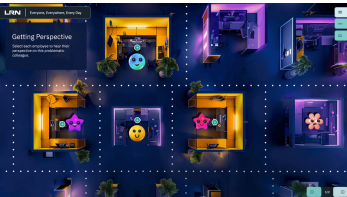
The core of the program is a role-based, scenario-driven design. Employees follow tailored learning pathways aligned to their specific responsibilities, navigating realistic compliance situations through interactive, “choose-your-own-path” scenarios. This approach shifts the experience from passive content consumption to active participation, allowing learners to apply complex regulations in context.
The program was deployed across the entire US workforce, approximately 8,900 employees. Delivered through the company’s LMS, the streamlined format ensured accessibility, scalability and minimal disruption to business operations.
By combining immersive storytelling, role-based design and operational efficiency, Sanofi created a learning experience that strengthened both engagement and practical understanding.
Results
The program delivered significant impact across operational efficiency, engagement and organizational alignment. By consolidating multiple courses into a single curriculum, Sanofi reduced total training time per employee by 68%, decreasing seat time from approximately 190 minutes to just 60 minutes. This shift resulted in more than 19,000 hours of annual time savings across the organization and generated estimated payroll savings exceeding $1.4 million each year.
Despite the reduction in training time, engagement and effectiveness improved. The program achieved near-universal completion across the US workforce, supported by strong communication and leadership reinforcement. Learner feedback highlighted the clarity, relevance, and practical application of the content, with employees noting that the role-based scenarios made compliance concepts easy to understand and directly applicable to their work.
Beyond efficiency gains, the program strengthened alignment across the organization. By expanding all modules to all employees, Sanofi established a shared foundation for compliance, reinforcing accountability across functions and levels. The immersive, scenario-based design also increased confidence in decision-making, helping employees navigate complex regulatory situations more effectively.
Collectively, these outcomes demonstrate that the program not only reduced training fatigue but also enhanced understanding, engagement, and cultural alignment, delivering both measurable ROI and meaningful behavioral impact.
Conclusion
Sanofi’s Leading with Integrity in US Healthcare Compliance program demonstrates how organizations can modernize compliance training to meet both regulatory and business needs. By shifting from more static content to immersive, role-based learning, the program equips employees to apply complex regulations in real-world situations while improving efficiency at scale.
The initiative highlights the importance of aligning compliance training with organizational priorities, ensuring that learning supports both performance and accountability. It also reinforces the value of designing experiences that reflect employees’ day-to-day work, making compliance relevant, engaging and actionable.
Building on this success, Sanofi is exploring opportunities to extend this model across additional compliance areas, including privacy, and potentially expanding the approach beyond the US. Through this continued evolution, the organization is establishing a scalable framework for compliance excellence, one that strengthens both workforce capability and organizational integrity.