About Hasbro
Hasbro is a leading games, intellectual property, and toy company headquartered in Pawtucket, Rhode Island, with a history dating back to 1923. With approximately 4,500 employees and annual revenue of $4.7 billion, the company reaches a global audience of more than 1 billion people worldwide through a diverse portfolio of physical and digital games, video games, toys, licensed consumer products, and entertainment experiences across film, television, and location-based platforms.
Hasbro’s offerings include toys, action figures, puzzles, role-playing and trading card games, and interactive digital content, distributed through mass retailers, specialty and hobby stores, and digital platforms. As a publicly traded company on NASDAQ (HAS), Hasbro combines creativity, storytelling, and play to build joy and lasting connections with consumers worldwide. Central to this mission is a strong commitment to ethical business practices and a culture of integrity that supports long-term brand trust and loyalty.
The challenge
Hasbro’s prior Code of Conduct training was delivered through a creative and unique, in-person tabletop board game experience. Employees gathered in groups to navigate physical “lands” representing key compliance topics such as anti-bribery, antitrust, and mutual respect. The format was collaborative, discussion-driven, and widely appreciated.
As Hasbro evolved into a more digitally enabled and hybrid organization; Hasbro realized this format would be increasingly difficult to scale. Remote participation became a permanent part of the workforce.The company’s broader digital transformation initiatives called for a more flexible and accessible learning solution.
Hasbro needed to modernize its approach without losing what made the original experience impactful. The solution had to preserve the interactivity and energy of the board game, scale across a global and hybrid workforce, achieve near-universal participation as a mandatory program, and reinforce ethical behavior in a way that was engaging rather than procedural.
The solution
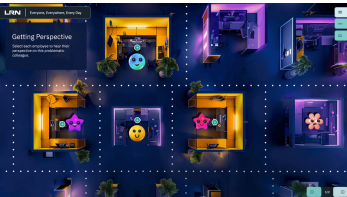
To meet these needs, Hasbro partnered with LRN to reimagine its Code of Conduct training through an immersive digital learning game. Rather than simply digitizing the existing format, the team redesigned the experience to align with Hasbro’s creative identity and storytelling strengths.This resulted in a narrative-driven digital board game where both hybrid and remote employees formed teams, selected a Game Master, and explored themed environments such as The Village, The Inn, Bogbottom, Thornwood, Dragon’s Hoard, and Troll Bridge. Each setting introduced ethical dilemmas through short cinematic videos, connecting compliance topics to realistic workplace scenarios.
As teams progressed through the game, they discussed and selected responses to scenario-based questions. Correct answers advanced their progress and increased a “wisdom meter,” while incorrect choices triggered real-time feedback, reinforcing learning and encouraging consultation with internal experts, mirroring real escalation pathways within the organization.
The program was delivered through live, facilitated sessions; ensuring consistency while enabling discussion and collaboration. A global rollout supported by executive leadership, including CEO communications, reinforced the importance of participation and ethical leadership.
By combining storytelling, gameplay, and team-based learning; the experience transformed compliance training into an engaging, participatory event that encouraged employees to actively and collaboratively apply the Code rather than passively review it.
Results
The program achieved strong global reach and engagement, with approximately 94% of Hasbro’s workforce completing the training by the end of the rollout. Delivered through 276 facilitated sessions, the initiative successfully scaled across regions while maintaining a consistent and interactive experience.
Beyond participation, the program drove meaningful engagement and behavioral impact. Employees actively discussed ethical dilemmas during gameplay, debated decision-making approaches, and demonstrated increased curiosity about how policies apply in real-world situations. This was reflected in the volume and quality of follow-up questions submitted to the compliance team, signaling deeper reflection and understanding.
Participant feedback further reinforced the program’s success, with participants consistently highlighting the experience as engaging, collaborative, and more effective than traditional training formats. Many noted that the game-based structure made it easier to apply concepts and encouraged teamwork and discussion.
Collectively, these outcomes show that the program succeeded in shifting compliance training from a passive requirement to an interactive experience that strengthens ethical awareness, dialogue, and decision-making across the organization.
Conclusion
Hasbro’s Code of Conduct Game demonstrates how organizations can modernize compliance training while staying true to their culture and identity. By transforming a beloved in-person experience into a scalable digital format, Hasbro preserved what made the training effective while expanding its reach and impact.
The program represents more than a format change; it reflects a broader shift toward making compliance learning engaging, relevant, and embedded in everyday decision-making. Built as a scalable foundation, the experience will continue to evolve, with opportunities to introduce more advanced scenarios, deeper topic exploration, and tailored content for different audiences.
Through this approach, Hasbro has reinforced a culture where ethical behavior is not just understood, but actively practiced, turning compliance into a shared, engaging experience across the global organization.
“Training people on a code of conduct isn’t typically the most exciting thing… but making something engaging and adding a level of competition made it interesting, educational, and enjoyable. People don’t realize they’re having fun and actually learning at the same time.”