About Sanofi
Sanofi is a global healthcare leader headquartered in Paris, France, with around 86,000 employees and operations in roughly 70 countries. Its products are distributed in 180 countries and serve patients, healthcare providers, pharmacies, hospitals, insurers, and government health systems. The company delivers a wide range of healthcare solutions and treatments across multiple therapeutic areas and is committed to upholding the highest standards of integrity, patient safety, and regulatory compliance.
In line with this mission, Sanofi has been strengthening its ethics and compliance (E&C) program, aiming to move beyond basic training toward a more data- driven, behavior-focused approach that supports ethical decision-making and proactive risk management across its global workforce.
The challenge
Historically, Sanofi evaluated compliance training using standard LMS metrics such as completion rates and satisfaction scores. While these indicators offered a basic view of engagement, they did not reveal whether employees truly understood complex topics, could navigate ethical gray areas, or were applying compliance principles in real-world situations. Several gaps became clear: traditional metrics did not show how employees behaved in scenario-based assessments, where they struggled, or where knowledge gaps might point to emerging risks. Without this depth of insight, it was difficult for the compliance team to identify potential vulnerabilities, tailor interventions, or demonstrate the real impact of training to senior leadership.
Sanofi needed a solution that would provide deeper behavioral insights into how learners responded to ethics and compliance scenarios, enable data-driven risk management by surfacing patterns and early warning signs across regions, roles, and courses, and equip the compliance department with robust analytics to support meaningful dialogue with risk owners and executives.
In short, the company wanted to transform compliance learning data into actionable intelligence that could both improve learning effectiveness and strengthen its overall risk posture.
Establishing a data-driven compliance strategy
Sanofi’s goal was to position learning analytics as a core pillar of its compliance and risk management strategy, not just an add-on to training administration.
The initiative was designed around three key objectives:
- Make learning data actionable: Go beyond completions to understand how learners perform on knowledge checks, where they hesitate, and how their understanding evolves over time.
- Embed insights in risk management: Regularly analyze and present learning analytics to risk owners so that training results directly inform risk assessments, mitigation plans, and program adjustments.
- Reach executive decision-makers: Elevate compliance learning metrics to Sanofi’s Executive Committee and senior leaders, enabling them to see where risks exist, which topics require reinforcement, and how training supports the company’s broader integrity and culture goals.
To achieve these aims, Sanofi needed a platform that could integrate seamlessly with its LMS, scale across global programs, and provide advanced, insights-first analytics that were easy for compliance teams and leaders to interpret and use.
The solution
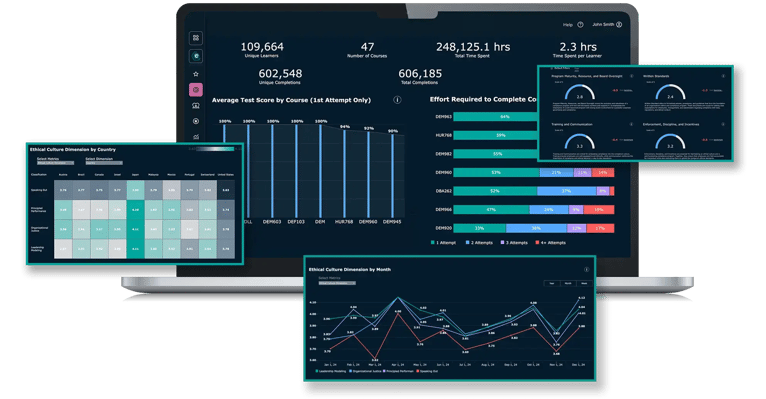
Sanofi implemented LRN’s Catalyst Reveal, an advanced analytics and insights platform purpose-built for ethics and compliance programs. Reveal centralizes training data and provides real-time visibility into participation, engagement, and decision patterns, allowing Sanofi to shift from static reporting to dynamic, behavior-focused analysis.
Sanofi adopted a phased implementation: first launching a one-year pilot on select global compliance courses to validate the integration, dashboards, and insights, then expanding to all new global compliance modules after successful testing. Catalyst Reveal was integrated into Sanofi’s existing LMS via AICC so that learners continued to access courses through the same familiar interface, while Reveal captured the underlying analytics behind the scenes.
Catalyst Reveal delivers real-time dashboards and visualizations that track completions, engagement, and performance across business units, regions, and roles, along with insights-first analytics that highlight where learners fail questions, require multiple attempts, or misunderstand key concepts, pinpointing potential risk areas. It also offers test-out and knowledge check analytics that reveal where content can be streamlined, clarified, or tailored for higher impact.
Throughout implementation, LRN trained Sanofi’s compliance administrators to use Reveal effectively, and Sanofi centralized ownership of compliance learning within the compliance team. Subject Matter Experts now focus on content, while the compliance learning team manages design, analytics, and delivery, ensuring consistent quality and strategic use of data.
Results
Sanofi now uses Catalyst Reveal to track three main areas: knowledge evolution, risk area understanding, and learning effectiveness.
For knowledge evolution, Reveal’s analytics on pre-assessment (test-out) and knowledge checks show how understanding improves over time. In recurring topics, such as in the Code of Conduct, Sanofi has seen stronger test-out performance year over year, indicating durable retention. Reveal has also flagged modules where many learners need multiple attempts. For example, when evaluating knowledge check attempts in their 2024 Code of Conduct course, Sanofi saw that 49% of learners required four or more attempts to pass a certain module. Further analysis revealed that the question format (e.g., multiple-select vs. single-answer) contributed to confusion, highlighting the need for improved language clarity. This "real-time" data enables rapid course refinements, improving both the learning experience and knowledge comprehension.
For risk area understanding, Sanofi analyzes response patterns on scenario-based questions in courses like data privacy and information security. These insights help the compliance team refine content, clarify complex concepts, and support risk owners with targeted follow-up.
For learning effectiveness, Sanofi monitors the number of attempts required to pass knowledge checks and has introduced voluntary test-outs across multiple courses. Approximately 90% of employees opt to take the pre-assessment when available, leading to training hours saved while ensuring employees remain focused on areas where they truly need more learning.
Beyond these metrics, Catalyst Reveal has improved executive engagement. Compliance learning data is now regularly presented to risk owners and the Executive Committee, reframing discussions around identifying risk patterns and defining appropriate responses. This shift has strengthened support for compliance initiatives and reinforced the role of learning as a strategic driver of risk management and ethical culture.
Conclusion
Sanofi’s implementation of LRN Catalyst Reveal has transformed its compliance training from a completion-driven activity into a source of rich, actionable insight about learner behavior and organizational risk. Centralizing ownership within the compliance team and engaging leaders early helped streamline implementation, reduce inefficiencies, and align training with broader risk and culture goals.
By focusing on knowledge evolution, risk identification, and learning effectiveness, Sanofi now uses analytics to refine content, target interventions, Internal and prioritize resources where they have the greatest impact. Looking ahead, the company plans to extend its use of Reveal beyond course-level analytics to broader ethics and compliance program dimensions such as sentiment.
What began as a move to improve training metrics has become a broader shift toward data-driven compliance, helping Sanofi build a stronger, more resilient ethical culture, where learning is not just about passing a course, but about making better, more informed decisions every day.