What compliance leaders in Japan need to focus on next
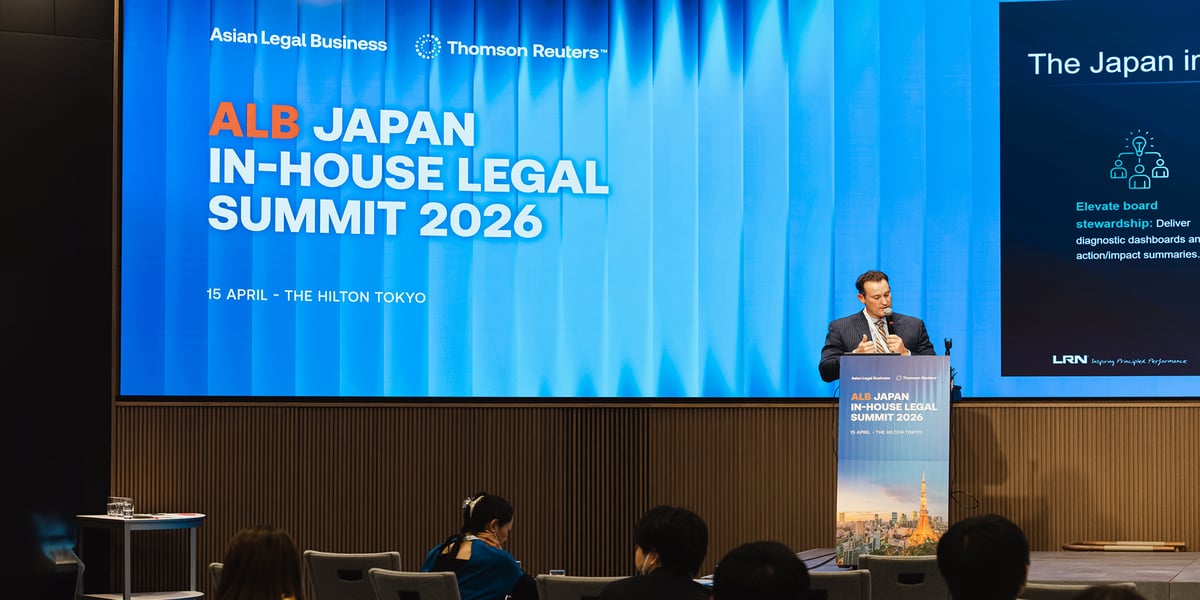
The ALB Tokyo In-House Legal Summit 2026 brought together legal and compliance leaders from across Japan to discuss the evolving demands on corporate governance and ethics programmes.
Held on April 15 in Tokyo, the summit provided a platform for in-house counsel and compliance professionals in Japan to exchange perspectives on regulatory pressure, organisational culture, and the increasing complexity of managing risk.
LRN was proud to participate, with SVP APAC Dean Rogers and Senior Business Development Manager Japan Noriko Yamakoshi presenting key takeaways from the 2026 Ethics and Compliance Programme Effectiveness Report (Japan Edition).
Across the session and discussions, six key findings emerged that highlight where compliance programmes in Japan are today, and where they must evolve.
From Activity to Impact: Global Insights from the 2026 Programme Effectiveness Report
Ty Francis MBE, CCEP, LRN’s Chief Advisory Officer, leads the organisation's global research and brings deep experience in ethics, compliance, and corporate governance. The 2026 Ethics and Compliance Programme Effectiveness Report draw on insights from over 2,500 professionals globally and, for the first time, expands into regional editions, including Japan's, to provide more targeted perspectives across key markets.
In the video below, Ty shares an overview of the report and highlights the global insights that set the context for today’s compliance landscape.
1. The performance gap is widening
High-impact programmes continue to pull ahead, while others improve only marginally.
As Dean noted during the session, many organisations are increasing investment in compliance by expanding tools, training, and reporting, but are not seeing the same improvement in outcomes.
“Organisations are doing more, but outcomes are not improving at the same pace.”
This gap between effort and effectiveness is becoming more visible. Many programmes are still measured by activity rather than their impact on behavior and decision-making.
As expectations from regulators, boards, and employees continue to rise, effectiveness is becoming the defining measure of success.
2. Technology adoption is increasing, but impact remains limited
Organisations are investing more in AI, analytics, and digital tools, but the impact is not yet fully realized.
“Technology is advancing, but adoption is still lagging behind how it should be used in practice.”
In many cases, tools are implemented but not connected to clear outcomes, limiting their ability to improve programme effectiveness.
The opportunity now is not just adoption, but integration. Organisations that successfully embed analytics into their processes are better positioned to identify risks, measure culture, and drive more informed decisions.
3. Culture remains the strongest driver of programme effectiveness
Despite advances in technology, culture continues to be the most reliable indicator of programme success. During his presentation, Dean highlighted:
“Companies with strong cultures perform better because employees feel confident to speak up and act ethically.”
Many organisations are placing greater emphasis on measuring culture, but translating values into consistent behavior remains a challenge.
The focus is shifting from awareness to application. Programmes are expected not only to define standards, but to influence how decisions are made in practice across all levels of the organisation.
4. Middle management remains the missing link
Managers are the link between leadership intent and employee behavior. They are responsible for translating expectations into everyday decisions.
Dean mentioned:
“Many middle managers are still caught between sales targets and ethical decision-making. As a result, we are seeing a growing gap between what managers want to do and what they actually can do.”
This disconnect can erode trust across the organisation and weaken the impact of even well-designed programmes.
Strengthening programme effectiveness requires equipping managers with the tools, guidance, and support they need to apply policies and reinforce ethical behavior consistently.
5. The governance paradox persists
Board oversight is evolving more slowly than the risks organisations face.
“Reporting that 100% of employees completed training doesn’t tell boards whether the training was understood or effective. Boards are increasingly asking for better data, including benchmarking and predictive insights, to understand how they compare to peers and what they should improve next.”
Many organisations continue to rely on static metrics such as training completion or hotline volumes, which provide limited insight into behavior or programme effectiveness.
Strengthening governance now requires moving beyond activity metrics and providing boards with clearer, more actionable visibility into risk, culture, and outcomes.
6. Third-party and regulatory readiness are advancing slowly
As the session concluded, one final theme stood out clearly. As supply chains become more complex, compliance risk is no longer confined within the organisation.
“Some suppliers have more access to your systems than your own employees, yet receive far less training.”
Many organisations invest heavily in training their own employees, but place far less emphasis on third parties that interact with critical systems, data, and operations every day.
This creates significant exposure, particularly in industries with complex ecosystems such as manufacturing, healthcare, and chemicals.
Strengthening programme effectiveness requires extending ethics and compliance expectations beyond the organisation by equipping third parties with the same standards, guidance, and training.
Taken together, these findings point to a broader shift in how compliance programmes are expected to operate.
Ethics and compliance programmes are evolving, but not yet at the pace required to meet today’s risks.
In Japan, these challenges are particularly pronounced, highlighting the need for a more focused and practical approach to improving programme effectiveness.
The Japan imperative for 2026: Moving from activity to impact
Across all of these findings, Dean Rogers brought the discussion back to a clear conclusion.
“The challenge is not doing more; it’s making compliance work in practice.”
Drawing on insights from the 2026 Programme Effectiveness Report Japan Edition, six priorities are emerging for organisations looking to strengthen programme effectiveness:
- Integrate ethics with analytics by linking culture metrics with risk signals
- Close the analytics gap, particularly where adoption lags global benchmarks
- Embed ethical intelligence at every level, especially through middle management
- Elevate board stewardship with more meaningful, insight-driven reporting
- Clarify the role of AI, moving from experimentation to practical integration
- Strengthen third-party oversight as supply chain risks continue to expand
These priorities reflect a broader shift in how compliance programmes are expected to operate.
The focus is no longer on activity alone, but on outcomes—on whether programmes are truly influencing behavior, improving decision-making, and strengthening organisational resilience.
Continuing the conversation
For organisations seeking a deeper view into trends specific to Japan, the 2026 Programme Effectiveness Report (Japan Edition) offers a deeper view into the trends, gaps, and opportunities shaping ethics and compliance today.
Wish to speak with an ethics and compliance expert about how to apply these practices within your program? Connect with our team to continue the conversation.